Practical local SEO for Malaysian food delivery: optimise your Google Business Profile, target neighbourhood and multilingual keywords, and define clear delivery zones.

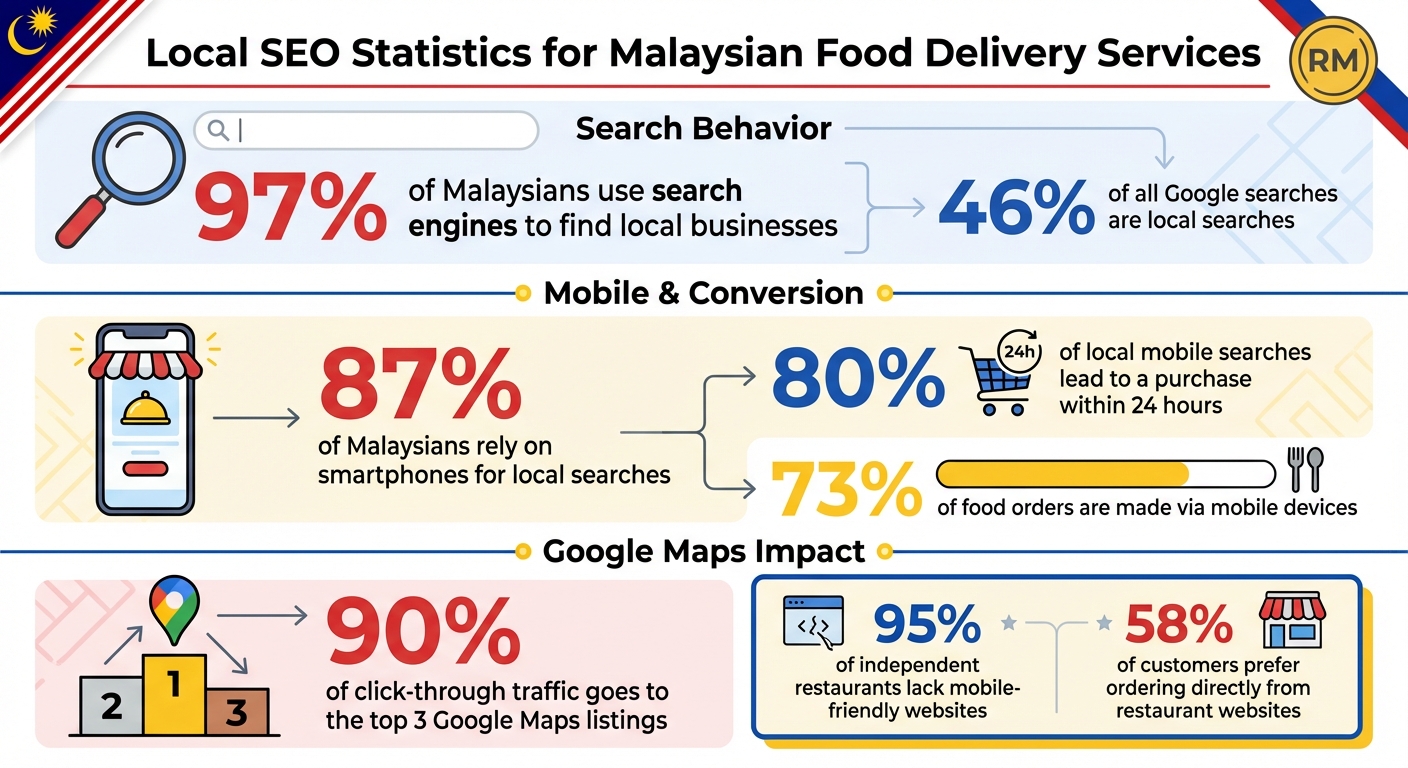
So why is this important? Because 97% of Malaysians use search engines to find local businesses, and 80% of local mobile searches lead to a purchase within 24 hours. This means showing up in searches like "nasi lemak near me" or "food delivery Bangsar" can directly drive orders. Here's what you need to know:
- Google Maps is key: 90% of click-through traffic goes to the top three listings. Ranking higher could mean more orders.
- Google Business Profile (GBP): Optimise your Google Business Profile with accurate details, photos, and reviews boosts visibility.
- Local keywords matter: Target neighbourhoods like Mont Kiara, Damansara, or Penang with specific search terms.
- Multilingual content: Use English, Bahasa Melayu, and Mandarin to reach diverse audiences.
- Customised delivery areas: Clearly define service zones to match local searches and avoid confusion.
Use Google Business Profile for Local Visibility

Your Google Business Profile (GBP) is like your virtual storefront - it’s often the first thing potential customers see when searching for nearby food options. With 87% of Malaysians relying on smartphones for local searches, having an optimised profile can make a big difference.
"We always recommend all SMEs to utilise and focus on their Google Business Profile and have consistent content updates. It will be especially useful when Google Map's Search with Generative AI features is fully rolled out".
How to set up and verify your profile to ensure you're making the most of this platform:
Setting Up and Verifying Your Google Business Profile
To get started, head to business.google.com and log in with a Google account dedicated to your business. Use your official business name as it appears on legal documents - steer clear of keyword stuffing (e.g., "Best Nasi Lemak KL Delivery") as this could get your profile suspended. Choose the most relevant primary category, such as "Malaysian Restaurant", and add up to nine secondary categories if applicable to improve your visibility in local searches.
Verification is required before you can manage your profile. Google offers several methods, including postcard, phone, text, email, or video verification. This process usually takes 24 to 48 hours but can sometimes stretch to a week. For businesses without a physical storefront, like delivery-only services, you can hide your address and instead define a "Service Area" by city, postal code, or radius - perfect for covering areas like Klang Valley or specific neighbourhoods in Penang. Ensure your phone number includes the +60 country code and set your operating hours in MYT for local accuracy.
Adding Localised Content for Malaysian Customers
Good visuals get you better engagement. Upload high-quality photos of popular dishes like your nasi lemak, roti canai, or laksa at least once a month. Google tends to favour profiles with regularly updated images. Use the menu editor to list dishes in local languages along with prices (e.g., "Nasi Lemak Ayam Berempah – RM12.90"). Reginald Chan highlights:
"Your Google Business Profile serves as your digital storefront, displaying crucial information in Bahasa Malaysia, English, and Chinese to cater to Malaysia's diverse population".
Don’t forget to set "Special Hours" for major holidays like Ramadan, Chinese New Year, and Deepavali. Use the Q&A feature to address common concerns, such as "Is this JAKIM Halal certified?" or "Is there parking near Bukit Bintang?". Weekly Google Posts are another great way to showcase limited-time promotions or new menu items, which boosts engagement and improves your Map Pack rankings.
Defining Your Delivery Radius
Distance plays a big role in Google’s ranking algorithm. Clearly defining your delivery radius helps the system match your business with local, high-intent searches. For example, if you serve areas like Damansara, Bangsar, and Mont Kiara, make sure to specify these locations. You can also set "More hours" specifically for delivery services to let customers know when you’re available. Clearly outlining your service area reduces confusion, avoids orders outside your zone, and helps maintain your reputation.
Targeting Local Keywords for Search Rankings
Once you've set up your Google Business Profile, the next step is zeroing in on the right keywords to attract local customers. Did you know that 46% of all Google searches are local searches? This shows just how crucial it is to use targeted phrases to improve your visibility online. As Terrence Ngu explains:
"When a potential customer in Kuala Lumpur searches for 'best nasi lemak near me'... they're not just looking for any business - they're ready to make a purchasing decision right now."
This makes keyword targeting an essential part of your local SEO strategy.
Researching High-Intent Keywords
Instead of broad terms like "Kuala Lumpur food delivery", focus on specific neighbourhoods such as Bangsar, Mont Kiara, SS2, Cheras, or Taman Connaught. This approach helps you stand out in your actual service areas, where competition is lower.
Tools like Google Keyword Planner, SEMrush, or Ahrefs can help you identify search volumes. For additional insights, check Google Autocomplete or the "People Also Ask" section to see what users are actively searching for. Look for keywords that reflect immediate intent, such as "halal food delivery Shah Alam", "24-hour mamak near me", or "fast pizza delivery Petaling Jaya." Reviewing competitor Google Business Profiles can also reveal valuable keywords used in titles, categories, and customer reviews - elements that often influence Map Pack rankings.
Using Long-Tail Keywords in Website Content
High-intent keywords are a solid foundation, but long-tail keywords can take your strategy further. These longer, more detailed phrases are especially useful for capturing specific customer needs. For example, instead of just "Thai food", think about phrases like "vegan Thai food delivery in Subang Jaya" or "authentic banana leaf rice from Damansara Heights."
You can naturally weave these phrases into your menu pages, blog posts, and meta descriptions. Creating dedicated landing pages for each neighbourhood - like "Food Delivery in Bangsar" or "Halal Cake Delivery in Shah Alam" - makes your content more relevant to local searches. Adding FAQ sections is another smart move, as they can address voice search queries like "Which restaurants offer 24-hour delivery in KL?" or "Where to order vegetarian food in Penang?". This aligns with the growing popularity of conversational searches on devices like Google Assistant and Siri.
Multilingual Keyword Strategies
To connect with Malaysia's diverse audience, consider keywords in English, Malay, and Mandarin. For instance, "food delivery" translates to "penghantaran makanan" in Malay and "外卖" in Mandarin. A search for "best chicken rice near me" could also appear as "nasi ayam sedap dekat saya" or "附近最好的鸡饭."
Incorporate bilingual title tags and meta descriptions, such as "Best Satay Delivery | Penghantaran Satay Terbaik", and use local terms like "mamak", "buka puasa", or "yum cha" to better connect with your audience. This strategy is especially important as 97% of Malaysian consumers use search engines to find local businesses.
Creating Localised Content and Location-Specific Pages
Once you've identified the right keywords, the next step is creating dedicated pages for each area you serve. These pages should be tailored to specific neighbourhoods, such as /locations/penang/ or /locations/klcc/, to connect with local customers effectively.
Building Location-Specific Pages
Each page should feature content that resonates with the local audience. Always display prices in Malaysian Ringgit (RM) and use the local date format (DD/MM/YYYY) to maintain relevance.
Avoid using the same content across multiple pages. Instead, customise each page with details unique to the area. For instance, a Bangsar page might highlight its proximity to Bangsar Village or Telawi Street, while a Penang page could mention Gurney Drive or specify delivery coverage in Georgetown. Include practical information like parking availability, nearby public transport, or popular events that locals care about. These local touches not only improve user experience but also strengthen your SEO strategy.
Using Schema Markup for Better Search Results
Once your pages are live, structured data can help search engines better understand your offerings. Schema markup allows you to highlight key details about your services, such as location, cuisine, and delivery options. For food delivery businesses, useful schema types include Restaurant, Menu, MenuItem, and LocalBusiness.
Use the areaServed property to specify the neighbourhoods you cover - like Mont Kiara, SS2, or Georgetown - and help search engines match your service to local searches. Adding aggregateRating can display star ratings in search results, while Menu and MenuItem schema ensure your dishes and prices appear as structured data, not just plain text. Avoid relying on PDF menus, as they’re not easily parsed by AI search tools.
For Malaysian customers, include structured data for halal, vegan, or gluten-free options to meet specific dietary needs. Additionally, use OpeningHoursSpec to reflect split shifts, such as separate lunch and dinner delivery times or special hours during Ramadan.
Adding Customer Testimonials
Localized content builds relevance, but authentic testimonials strengthen trust. Featuring reviews from satisfied customers in specific areas shows both search engines and potential customers that you actively serve the community. Instead of generic feedback, highlight location-specific testimonials like:
- "Best nasi lemak delivery in Bangsar!"
- "Super fast service to Kelana Jaya every time."
Encourage customers to leave reviews on the Google Business Profile for their neighbourhood. Reviews in the customer’s preferred language - whether English, Bahasa Malaysia, or Mandarin - can resonate more effectively. Responding to reviews promptly, ideally within 24–48 hours, shows active engagement. This is crucial, considering that 80% of mobile local searches in Malaysia lead to a purchase or store visit within 24 hours. Localised testimonials can often be the deciding factor for potential customers.
Using Maynuu to Support Local SEO Efforts

Maynuu takes your local SEO game to the next level by providing a strong technical foundation that complements your existing strategies. For food delivery businesses, this platform not only improves search visibility but also simplifies daily operations. By addressing essential ranking factors like mobile responsiveness and secure payments, Maynuu ensures your business aligns with what search engines value most. Here's how its features can enhance your local SEO strategy.
Customisable Online Menu Creation
An online menu isn't just a list of dishes - it’s an important tool for SEO. Maynuu helps you create menus that are not only visually appealing but also search engine-friendly. Using JSON-LD markup, these menus allow Google to easily index details like dish names, RM pricing, and dietary tags such as "halal" or "vegetarian." This is especially important in Malaysia, where 73% of food orders are made via mobile devices, yet 95% of independent restaurants lack mobile-responsive websites. Maynuu bridges this gap, giving you a clear edge.
Menus can be categorised into sections like "Specials", "Mains", or "Bundles", with descriptions that include keywords like "best char kuey teow in Penang." On top of that, the platform incorporates technical SEO essentials such as HTTPS security, which can increase click-through rates by 12%, as well as image compression and fast loading times.
Delivery and Payment Integration
Maynuu goes beyond menu creation by offering a seamless ordering experience, which not only boosts conversions but also strengthens your SEO efforts. The platform integrates with popular local payment gateways like Stripe, Billplz, and Curlec, alongside widely-used methods in Malaysia such as DuitNow and GrabPay. This ensures a smooth transaction process for customers searching for nearby options.
Maynuu also lets you define delivery areas by distance, which enhances local relevance in search results. By managing your own direct ordering system instead of relying solely on third-party platforms, you retain control over customer data and branding while avoiding hefty commission fees. With 58% of customers preferring to order directly from a restaurant’s website or app, this approach not only boosts your SEO but also protects your profit margins.
Sales Analytics for Data-Driven Decisions
Data is everything when it comes to refining your local SEO strategy, and Maynuu’s analytics dashboard delivers exactly that. It identifies high-value postcodes like Bangsar or SS2 and highlights top-selling dishes, allowing you to create targeted landing pages that drive conversions. These insights also help you optimise your Google Business Profile by featuring popular dishes and using high-intent keywords in menu descriptions, ensuring you attract the right audience at the right time.
Monitoring and Improving Local SEO Performance
Local SEO is not something you set up once and forget - it demands regular tracking and fine-tuning to maintain an edge over competitors. The trick lies in identifying the right metrics and acting on the insights they provide.
Tracking Rankings for Local Keywords
Google Search Console (GSC) is a go-to tool for checking how your food delivery business is performing in local searches. You can filter performance reports by queries that include specific neighbourhood names like "Bangsar", "Mont Kiara", or "SS2." This gives you a clear view of where your business is gaining visibility and where it needs improvement. For instance, if a term like "halal mamak delivery PJ" gets plenty of impressions but few clicks, revisiting your meta titles and descriptions could help boost click-through rates.
For more granular data, tools like Whitespark or BrightLocal can provide street-level ranking insights, which is especially handy in dense areas like Kuala Lumpur or Petaling Jaya.
Once you've tracked your rankings, the next step is to evaluate how these rankings translate into user engagement on your website.
Measuring Traffic and Conversions
Rankings are just one piece of the puzzle. To fully understand your performance, you need to analyze visitor behavior. Google Analytics (GA) is invaluable here, allowing you to create a geo-specific view that filters traffic from your delivery zones. This helps separate local customers from broader national traffic, giving you a clearer picture of your audience.
Keep an eye on metrics like bounce rate, time spent on site, and RM revenue generated from orders. Use UTM parameters in your Google Business Profile (GBP) website link (e.g., ?utm_source=google&utm_medium=organic&utm_campaign=gmb-listing) to differentiate traffic from the Map Pack versus organic search results. GBP Insights also provides data on calls, directions, and website clicks - key indicators of customer intent.
However, as local SEO expert Joy Hawkins points out:
"Many business owners are extremely confused about what the 'views' element represents... this graph does not represent how many users saw, searched for, or interacted with your Google listing".
Adjusting Strategies Based on Data
Once you've gathered insights, it's time to adjust your approach. For example, if GA reveals that customers from a specific postcode, like 50450 or 47301, are converting at higher rates, you might want to create more targeted content for those areas or shift your marketing budget to focus on them.
If your data shows high traffic but low conversions in certain neighbourhoods, consider refining your landing pages to better align with local user needs. When rankings drop, reviewing what your competitors are doing can also offer valuable clues.
To measure the profitability of your efforts, calculate your marketing ROI using this formula:
ROI (%) = [(Revenue from Campaign - Cost of Campaign) / Cost of Campaign] × 100
And always analyse data year-over-year rather than month-to-month. Seasonal events like Ramadhan or Chinese New Year can naturally impact customer behaviour in Malaysia.
| Metric | Tool | Purpose |
|---|---|---|
| Local Organic Traffic | Google Analytics | Tracks visitor volume from target regions |
| Local SERP Rankings | Semrush / Whitespark | Monitors rankings for location-specific queries |
| Customer Actions | GBP Insights | Tracks calls, directions, and bookings |
| Search Queries | Google Search Console | Identifies high-intent local keywords |
| RM Revenue | Maynuu / GA Goals | Measures actual conversions and ROI |
Conclusion
For food delivery businesses in Malaysia, local SEO isn't just a nice-to-have - it’s a must-have. It can make the difference between being the go-to option for hungry customers or being overlooked entirely. With 97% of Malaysians searching for local businesses and 80% of mobile searches leading to a purchase within 24 hours, your online presence directly impacts your sales.
The steps to get started are simple yet effective: optimise your Google Business Profile, use hyperlocal keywords (like "Bangsar" or "SS2"), ensure your NAP (Name, Address, Phone) details are consistent across platforms, and stay on top of customer reviews. These are the building blocks of local SEO success in Malaysia, helping you attract customers who are ready to place an order.
But don’t stop there - your website’s technical performance plays a huge role too. A slow, clunky site can cost you orders. For example, a menu that takes longer than 3 seconds to load can drive away potential customers, especially since 73% of Malaysians order food via mobile devices. Adding schema markup also ensures Google can easily index your menu items.
This is where platforms like Maynuu can make your life easier. Maynuu provides a search engine-optimised ordering site that’s mobile-friendly, includes automated sitemaps, and runs on secure HTTPS. It's tailored for Malaysian businesses, complete with RM currency and local time zones. With this solid technical foundation, you can focus on what you do best - serving delicious food.
FAQs
How can I improve my Google Business Profile to attract more local food delivery customers in Malaysia?
Start by claiming and verifying your Google Business Profile (GBP). This step is essential to build trust and improve your ranking in local search results. Make sure your business name, address, and phone number (NAP) are accurate and consistent across all platforms. Consistency helps customers find you easily and boosts your local SEO.
Write a clear and informative business description with relevant keywords. This makes it easier for nearby customers searching for your services to discover your profile. For instance, if you’re a café in Kuala Lumpur, include terms like “specialty coffee in KL” or “best café for brunch in Bukit Bintang.”
Photos matter more than you think. Upload high-quality images of your menu, delivery areas, or unique features like your cosy seating or signature dishes. These visuals not only make your profile more attractive but also help potential customers decide faster.
Keep your profile updated with promotions, new menu items, or announcements. Regular updates signal that your business is active and engaged, which can encourage more interactions.
Don’t underestimate the power of reviews. Ask satisfied customers to leave feedback and make it a point to respond to them - whether they’re positive or negative. Engaging with reviews shows that you value customer opinions and can influence others to choose your business.
Lastly, take advantage of GBP insights to track your profile’s performance. Use this data to refine your strategies and cater to Malaysia’s diverse audience, including multilingual content if needed. Little tweaks based on insights can make a big difference in how your business connects with the local community.
How can food delivery businesses optimise for local keywords?
To make the most of local keywords, start by keeping your Google Business Profile accurate and updated. Include essential details like your business name, address, and phone number (NAP). Use relevant local keywords in your profile description, such as "food delivery in Kuala Lumpur" or "best nasi lemak near Petaling Jaya." Positive reviews from satisfied customers can also improve your visibility in local search results, so don't hesitate to encourage them.
On your website, weave location-specific keywords into your content. This could be on your menu pages, blog posts, or promotional sections. For instance, mention your delivery zones or reference nearby landmarks to make your content more relevant. Since many Malaysians rely on their smartphones for food delivery searches, ensure your site is mobile-friendly and loads quickly. Collaborating with local blogs or directories to gain backlinks is another smart way to boost your local search rankings.
By using these approaches, food delivery services can better reach nearby customers and increase orders efficiently.
Why is multilingual content crucial for improving local SEO in Malaysia?
In Malaysia, the diversity of languages spoken reflects the country's vibrant mix of cultures. With Malay, English, various Chinese dialects, and Tamil being commonly used, having multilingual content is a smart way for businesses to connect with different communities and expand their reach.
When your website is optimised for multiple languages, it doesn’t just make things easier for users - it also helps search engines like Google match users with the right language version of your site. For food delivery services, this means being able to cater to more local customers, show up in relevant searches, and ultimately drive more orders and engagement.
---
We use the term 'restaurant' throughout the article for consistency. However this guide can be generally applied to any type of food shop, including but not limited to: bakeries, bars, bistrots, boulangeries, butcheries, cafés, caterers, coffeeshops, delis, diners, eateries, food trucks, patisseries, pubs, etc.
Maynuu
❇️ Create your FREE digital menu to link to Google Business Profile today